Breakfast & Brunch
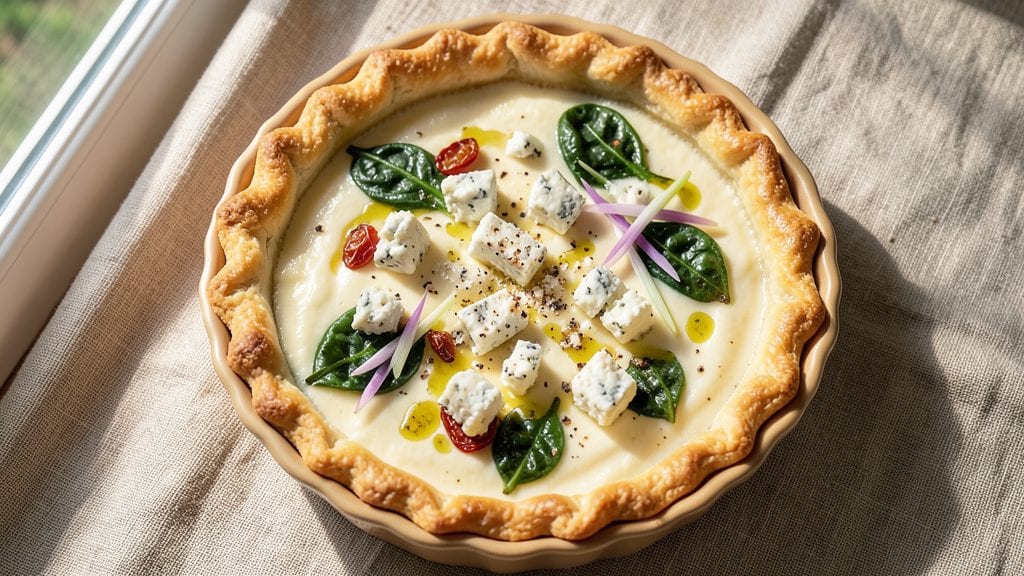
A feta cheese quiche recipe with a flaky crust and tangy, melty center transforms breakfast into a restaurant-worthy meal. The secret lies in a buttery, pre-baked crust that stays crisp while the custardy filling sets perfectly—no soggy bottoms here.
I’ve tested this recipe countless times, and the balance of eggs, cream, and feta creates a filling that’s rich yet light, with just enough lemon zest to brighten the salty cheese.
What makes this quiche special is its versatility—whether you opt for a homemade crust (for that professional flake) or a store-bought shortcut (for convenience), the method ensures a golden, crisp shell. The filling combines eggs and heavy cream for a velvety texture, while crumbled feta delivers that signature tangy bite.
A sprinkle of fresh herbs at the end adds freshness without overpowering the flavors.
Baking at 375°F for 35–40 minutes guarantees a set custard with a slightly jiggly center—just how it should be. The aroma alone will wake up your kitchen, and the first bite delivers that perfect harmony of crisp, creamy, and salty.
This quiche is ideal for brunch gatherings, meal prep, or a satisfying solo breakfast when you crave something heartier than toast.
Serve it warm with a simple arugula salad or crusty bread to soak up every last bite. The crust stays crisp even when sliced, and the filling holds together beautifully for easy transport. Here’s how to make it—step by step, with techniques that ensure flaky perfection every time.
Ingredients for feta cheese quiche
Six ingredients transform simple pantry staples into a restaurant-quality feta quiche with golden crust and velvety filling.
| Ingredient | Amount | Notes |
|---|---|---|
| Unsalted Butter 🧈 | 1 ½ cups | Cold, cubed for flaky crust |
| All-Purpose Flour 🌾 | 2 ½ cups | Bread flour for extra flakiness |
| Ice Cubes ❄️ | 1 cup | For tender crust texture |
| Large Eggs 🥚 | 4 whole | Room temperature preferred |
| Heavy Cream 🥛 | 1 cup | Full-fat for rich custard |
| Whole Milk 🥛 | ½ cup | Warmed slightly for smooth filling |
| Crumbled Feta Cheese 🧀 | 1 ½ cups | High-quality, brined feta |
| Diamond Crystal Kosher Salt 🧂 | 1 ½ tsp | Adjust to taste |
| Freshly Ground Black Pepper 🌶️ | ½ tsp | Freshly cracked preferred |
| Lemon Zest 🍋 | 1 tbsp | Finely grated, organic preferred |
| Fresh Dill 🌿 | ¼ cup | Chopped, stems removed |
| Fresh Chives 🌿 | ⅛ cup | Finely chopped for garnish |
The crust demands attention to detail. European-style butter from brands like Plugrá or Land O'Lakes delivers the highest fat content for flakiness, while King Arthur bread flour enhances structure. Chill your butter and flour mixture for at least 30 minutes before rolling—this prevents gluten development and ensures those delicate layers. For the feta, Kalata or Greek varieties from specialty markets provide optimal salt balance and melt beautifully. Avoid pre-crumbled feta, which often contains anti-caking agents that prevent proper melting in the custard.
No heavy cream? Whole milk plus 2 tablespoons melted butter mimics the richness, though texture will differ slightly. Substitute feta with goat cheese or ricotta for a milder profile, but reduce the amount by one-third to avoid a watery filling. Fresh herbs can be swapped for dried dill or marjoram at one-quarter the quantity, though fresh delivers superior brightness. For a gluten-free crust, Bob's Red Mill 1:1 baking flour works well when combined with xanthan gum—just increase the butter by one tablespoon to compensate for reduced fat content.
Store the crust dough between parchment paper in the fridge for up to 2 days or freeze for 3 months for convenience. The assembled quiche keeps in the fridge for 4 days when tightly wrapped, though the crust loses crispness after 2 days. For meal prep, slice and reheat portions at 350°F for 10 minutes—the filling reheats beautifully while the crust regains its golden sheen. Freeze the fully baked quiche for up to 2 months by wrapping tightly in foil and thawing overnight in the fridge before serving.
Why You'll Love This Recipe
- No-Fuss Crust: I swear by the ice-cold butter trick—just pulse it with flour until it looks like wet sand. No rolling pin, no stress, and that flaky texture? It’s foolproof, even if my pie crusts usually end up lopsided.
- Salty Creamy Magic: That first bite of warm, gooey feta melting into the custard? Chef’s kiss. The heavy cream makes it rich without being heavy, and the eggs tie everything together—like a hug in dish form.
- Weeknight or Weekend: Make it for a lazy Sunday brunch or throw it together before a dinner party. It reheats beautifully, so leftovers taste just as good as day one. Honestly, I’ve served it at both—no one ever asked which was which.
- Budget-Friendly Luxury: You’re using pantry staples here: butter, flour, eggs. The feta adds that fancy touch, but it’s still cheaper than takeout. Plus, one quiche feeds four—so it’s basically a meal for the price of one.
Step-by-step instructions for feta cheese quiche
Master the art of flaky crust and creamy feta filling with this precise method.
Prepare the Flaky Pastry Dough
In a large mixing bowl, combine the 1.5 cups unsalted butter (cold and cubed) with the 2.5 cups all-purpose flour and 1.5 teaspoons diamond crystal kosher salt. Using a pastry cutter or your fingers, work the butter into the flour until you achieve a coarse crumb texture with pea-sized butter pieces—this ensures maximum flakiness in your crust.
Add the 1 cup ice cubes one at a time, gently tossing the mixture until the dough begins to come together. Avoid overworking the dough—just until it forms a shaggy mass. The ice cubes will create steam during baking, resulting in that signature tender, flaky texture. Once combined, divide the dough into two equal portions and flatten each into a disk. Wrap each disk tightly in plastic wrap and refrigerate for at least 30 minutes to firm up.
Roll and Blind-Bake the Crust
Preheat your oven to 375°F. On a lightly floured surface, roll out one of the dough disks into a 12-inch circle, about ⅛-inch thick. Gently transfer the rolled dough to a 9-inch pie dish, trimming any excess dough that hangs over the edges. Press the dough firmly into the bottom and up the sides of the dish to create a smooth, even surface.
Line the chilled crust with parchment paper and fill it completely with pie weights or dried beans. Bake for 15 minutes until the edges begin to turn lightly golden. Remove the weights and bake for an additional 5 minutes until the crust is fully set and just beginning to color. The goal is a crisp, golden foundation that won't sog when the filling is added.
Prepare the Tangy Feta Filling
In a medium bowl, whisk together the 4 whole large eggs, 1 cup heavy cream, 0.5 cup whole milk, 1.5 cups crumbled feta cheese, 0.5 teaspoon freshly ground black pepper, 1 tablespoon lemon zest, and 0.25 cup chopped fresh dill. The mixture should be smooth but still slightly thick—this ensures a rich, custardy texture without being watery. Season with an additional ½ teaspoon diamond crystal kosher salt if needed, tasting as you go.
Stir in 0.125 cup finely chopped fresh chives just before pouring the filling into the pre-baked crust. The chives add a bright, oniony finish that cuts through the richness of the feta and cream. Pour the filling into the hot crust, spreading it evenly with a spatula. The residual heat from the crust will help set the filling more quickly.
Bake Until Golden and Set
Return the quiche to the oven and bake for 35-40 minutes at 375°F, until the filling is just set and the top is golden brown. You'll know it's ready when the center is still slightly jiggly (like a custard) but the edges are fully set. Avoid overbaking—this is the most common mistake, and it leads to a dry, rubbery quiche.
To test doneness, gently shake the quiche—if the filling wobbles slightly but doesn't feel liquid, it's perfect. If the edges brown too quickly, loosely cover them with aluminum foil after 20 minutes to prevent over-browning while the center finishes cooking. Let the quiche rest for 10 minutes before slicing—this allows the filling to firm up slightly and makes serving easier.
Pro Tips For Making Feta Cheese Quiche
- CHILL THE CREAM FIRST: Heavy cream straight from the fridge whips up faster and holds volume better. Give it 10 minutes in the fridge before mixing—this isn’t just about texture, it’s about keeping your quiche filling light and fluffy instead of dense. (Yes, I’ve made the heavy, sad version. Don’t do that.)
- SALT THE BUTTER: Unsalted butter in a quiche needs salt—about ½ teaspoon per ½ cup. Skipping this makes the crust taste bland, and the feta’s saltiness will overpower everything. Trust me, your taste buds will notice the difference.
- DON’T OVERMIX THE FILLING: Once you fold in the feta, stop stirring. Overmixing breaks the egg curds and turns your quiche into scrambled eggs in a crust. A few gentle swirls with a spatula is all it takes—just enough to distribute the cheese evenly.
- BAKE IN A COLD PAN: Place your quiche dish on a baking sheet before sliding it into the oven. This prevents the bottom from getting too hot too fast, which guarantees a soggy crust. A cold pan = crispy, golden edges every time. (I learned this after one disastrous, weepy quiche.)
Regional styles of this dish
French Rustic Version
In France, quiche is often more rustic—this adaptation replaces the traditional pie crust with a pâte brisée (shortcrust pastry) made with 1 cup all-purpose flour, ½ cup cold butter, and ¼ cup ice water.
The filling swaps feta for 1 cup crumbled Brie or Comté cheese, and adds 1 tbsp Dijon mustard for depth. Bake at 350°F for 30 minutes in a 9-inch tart pan for a delicate, buttery base.
Serve with a green salad dressed with vinaigrette and a glass of Sancerre white wine for an authentic brunch experience. 🍷
Greek-Inspired Spinach
Greek quiches often incorporate fresh spinach and sun-dried tomatoes for a Mediterranean twist. Sauté 2 cups chopped spinach and ½ cup chopped sun-dried tomatoes in 1 tbsp olive oil until wilted, then mix into the filling along with the feta.
Add 1 tsp dried oregano and ½ tsp red pepper flakes for warmth. Top with ¼ cup crumbled feta before baking. This version pairs beautifully with tzatziki sauce or a Greek salad on the side. 🌿
Italian Herb & Sun-Dried Tomato
For an Italian-inspired quiche, replace the dill with 1 tbsp chopped fresh basil, 1 tbsp chopped fresh rosemary, and ½ cup chopped sun-dried tomatoes. The filling also includes ¼ cup grated Parmigiano-Reggiano for extra umami.
Use 1 cup whole milk instead of heavy cream to keep it lighter. Bake in a pre-baked puff pastry crust for a flaky, golden finish. Serve with garlic bread and a Chianti Classico for a hearty brunch. 🍅
American Southern Buttermilk
Southern cooks often use buttermilk in their quiches for extra tang. Replace the heavy cream with 1 cup buttermilk and add 1 tbsp cornmeal to the filling for thickness. Swap feta for 1 cup sharp Cheddar cheese and add ½ tsp smoked paprika for a subtle smoky note.
Bake in a deep-dish pie crust at 375°F for 40 minutes. This version is perfect with collard greens or cornbread on the side. 🧀
Modern Vegan Adaptation
For a vegan twist, use a store-bought vegan pie crust (like Bob’s Red Mill) and replace the eggs with 1 cup unsweetened soy milk mixed with 1 tbsp cornstarch and 1 tbsp nutritional yeast for a cheesy flavor.
Use 1.5 cups vegan feta (like Violife) and add 1 tbsp white miso paste for umami. Top with fresh herbs before baking at 375°F for 35 minutes. Serve with avocado slices and pickled onions for a fresh, plant-based brunch. 🌱
Nutrition facts
Frequently asked questions
Can I use store-bought crust instead of making it from scratch?
For convenience, use a pre-made pie crust or puff pastry. Just ensure it's fully baked (blind-bake if needed) for 15 minutes at 375°F before adding the filling. A store-bought crust works perfectly—just avoid pre-baked ones with soggy bottoms. This shortcut saves time without sacrificing flavor!
Why does my quiche filling get watery?
Watery filling usually happens from overmixing the eggs or using too much liquid. Whisk eggs and cream just until combined, then fold in feta gently. For extra thickness, add 1 tablespoon cornstarch to the filling. Also, ensure your crust is fully pre-baked to absorb excess moisture during baking.
How do I prevent a soggy crust?
A soggy crust is the #1 quiche mistake! Always pre-bake the crust for 15–20 minutes with pie weights or dried beans. For extra insurance, brush the hot crust with a thin layer of egg wash (1 egg yolk + 1 tablespoon water) before adding the filling. This creates a barrier that keeps the crust crisp.
Can I make this quiche ahead of time?
Yes! Assemble the quiche (unbaked) and refrigerate for up to 24 hours before baking. For leftovers, store in an airtight container for 3–4 days. Reheat slices at 350°F for 10 minutes to restore crispness. The filling reheats beautifully, while the crust stays golden and flaky.
What’s the best way to serve this feta quiche?
Warm slices pair perfectly with arugula salad (tossed in lemon vinaigrette), crusty sourdough, or roasted cherry tomatoes. For a brunch spread, add Greek olives or tzatziki sauce on the side. Serve immediately after baking for the best texture—crisp crust and creamy filling!